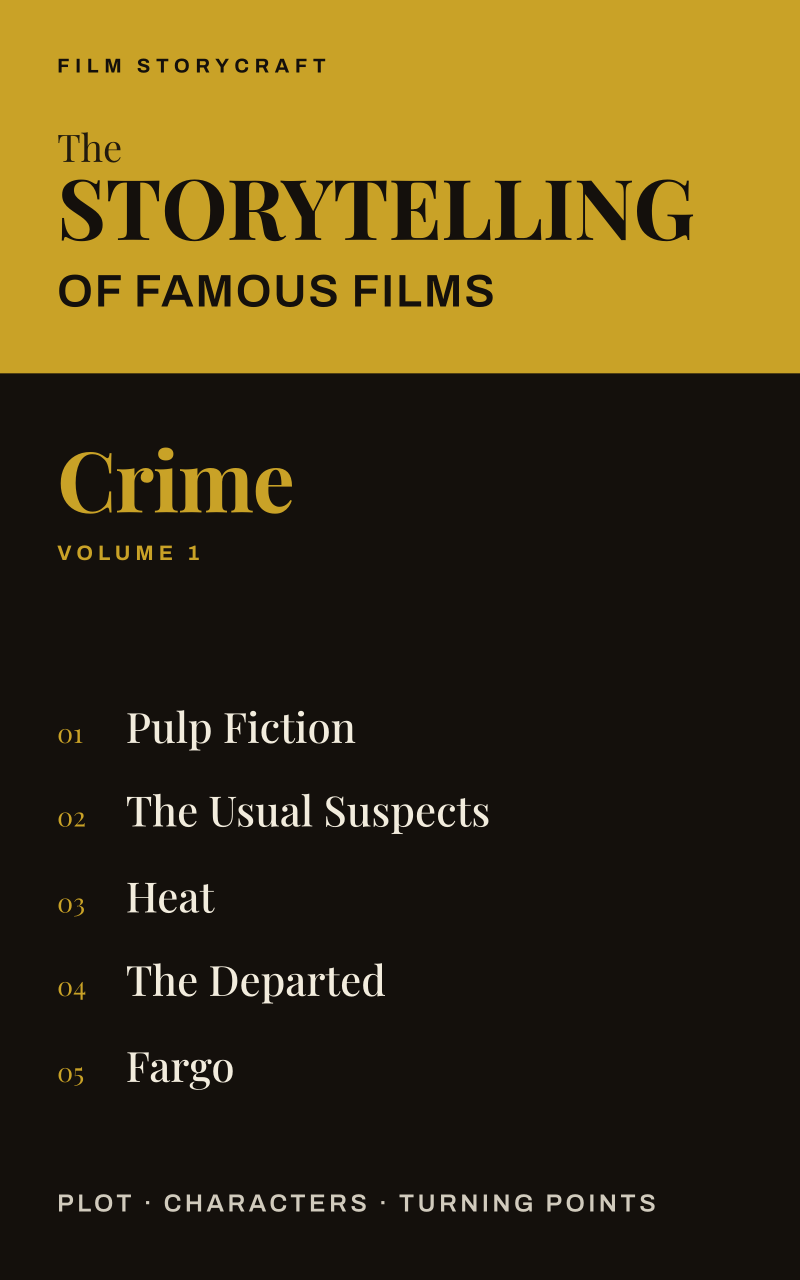
Crime — Volume 1: Where the moral center moves
Why do the three out-of-order stories of Pulp Fiction never lose us?
Book language: English · PDF + EPUB
Your ebooks, ready now and whenever you want
- Download right after payment
- An email with your download links, easy to find later
- Your personal library: sign in with your email and download again whenever you want
- PDF and EPUB for common devices, available from your library
The volume
A crime film promises a fixed point from which everything else can be measured: a badge, a code, a voice that does not lie. These five keep the promise, and every time they put that point where nobody would look for it. They hand it to a contract killer, to the voice with the most to gain from the credit we extend it, to two opponents of equal weight that the story refuses to sort into good and bad, to two masks with no face left underneath, to a small-town cop seven months pregnant. Every shift costs the film something the genre cared about, and every time it is the form that pays: the timeline rearranged, the story put in the mouth of a liar, the time granted to domestic scenes. The volume that teaches you to make a structural choice and a moral position the same decision.
The five films, and why they are here
Pulp Fiction
Reordered chronology as an act of judgment: the story rewards the one who changes, and gives him the last scene.
The Usual Suspects
The unreliable narrator taken to the limit: almost everything we see exists because somebody is saying it.
Heat
Two mirrored antagonists treated as equals: how to build the talk scene that outweighs every shootout.
The Departed
Two masks and no face: when judgment slides from the individuals to the rooms that produced them.
Fargo
The moral measure handed to the person the genre leaves at the margins, and spoken quietly once it is all over.
Inside the volume
- Introduction to the genre: the essay that binds the volume's five titles together and says what to watch for.
- Five analytical chapters, one per film, from the dramatic premise to the legacy of the work.
- Comparative glossary: thirteen or fourteen craft concepts, tested against these five titles.
- Over two hundred pages, in PDF and EPUB, in your account library.