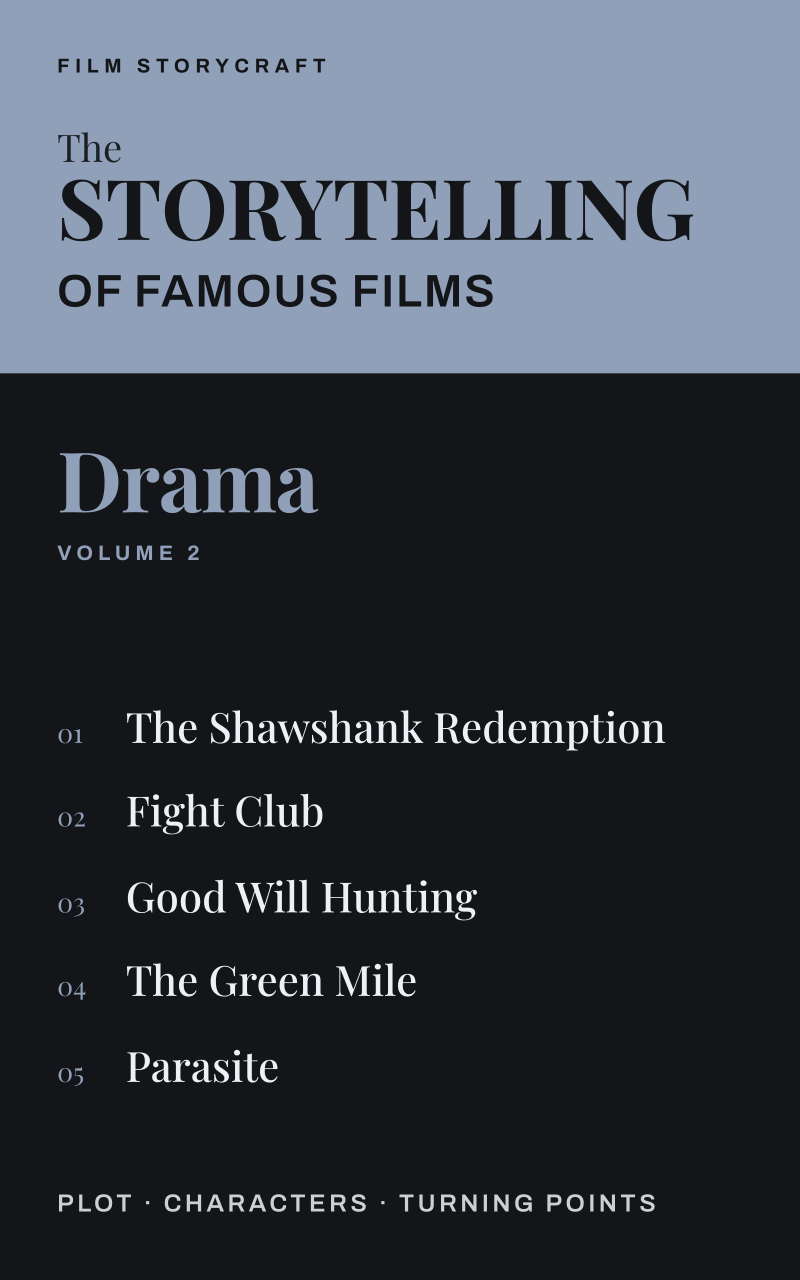
Drama — Volume 2: What no place can assign you
Long time spans, unreliable narration and tonal control, handled as craft problems.
Book language: English · PDF + EPUB
Your ebooks, ready now and whenever you want
- Download right after payment
- An email with your download links, easy to find later
- Your personal library: sign in with your email and download again whenever you want
- PDF and EPUB for common devices, available from your library
The volume
Five men inside structures that assign them a place: a prison, a courtroom, a market, a stairway in a poor neighborhood, a corridor walked in counted steps. None of these machines needs to hate anyone in order to work, and none of them can be fought the way an opponent is fought. So the five do not fight a man: they defend a part of themselves, and each film measures how much of it is left at the bottom. One keeps its secret in plain sight for two hours, counting on nobody looking. One gives up the question of how it will end and accumulates weight in place of suspense. One removes every external obstacle and moves the battle into conversations that take down one degree of guard at a time. This is the volume on long durations, on the narrator and on tone: three things drama cannot afford to get wrong.
The five films, and why they are here
The Shawshank Redemption
The narrator standing next to the protagonist: the one who tells is not the one who acts, and the price of the assigned place is paid by a third man.
Fight Club
Handing the audience every clue it needs and counting on it not lining them up before the last scene.
Good Will Hunting
Drama with no external obstacle: scenes almost entirely spoken, each one built to remove a single degree of defense.
The Green Mile
Giving up suspense and accumulating weight instead: three hours that know from the beginning how they will end.
Parasite
Geography as social structure: a doorbell at the exact midpoint, and a comedy that never comes back from it.
Inside the volume
- Introduction to the genre: the essay that binds the volume's five titles together and says what to watch for.
- Five analytical chapters, one per film, from the dramatic premise to the legacy of the work.
- Comparative glossary: thirteen or fourteen craft concepts, tested against these five titles.
- Over two hundred pages, in PDF and EPUB, in your account library.