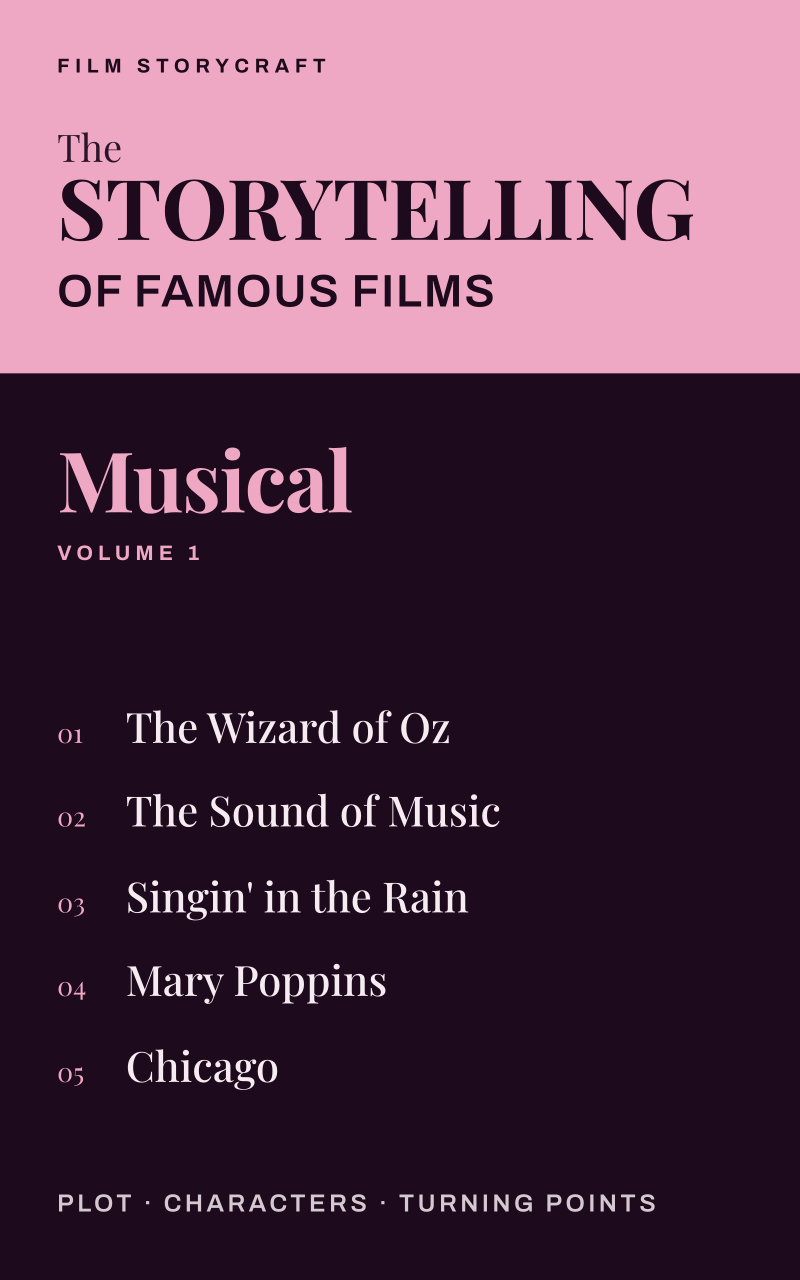
Musical — Volume 1: Why these people are singing
Five different answers to the question the genre is founded on.
Book language: English · PDF + EPUB
Your ebooks, ready now and whenever you want
- Download right after payment
- An email with your download links, easy to find later
- Your personal library: sign in with your email and download again whenever you want
- PDF and EPUB for common devices, available from your library
The volume
The question has followed the genre from the beginning, and the answer a film gives itself does not stay on the surface: it establishes who has a right to a number, where the scene ends and the show begins, how much the viewer is meant to believe of what passes in front of them. These five answer in five ways that do not fit together. One fuses fairy tale and song into a single machine and stops the question from arising. One gives the most literal answer: these people sing because somebody taught them to, inside the story. One takes singing as its own subject and tells of the passage from silent film to sound. One puts it in the hands of a newcomer, and runs an adult story of a father and his children under the bright surface. The last shuts it inside a single head, and every number becomes the world as somebody wishes it were.
The five films, and why they are here
The Wizard of Oz
Desire put into song in the first minutes as the engine of the whole film, and a route made visible as a line on the ground.
The Sound of Music
Singing moves from lesson to household habit and finally to public number: that is why the third act can change genre.
Singin' in the Rain
When singing is both the trade of the characters and the crisis that overwhelms them, theme and form coincide.
Mary Poppins
A bright surface working entirely for an adult change: the one who is transformed is the father, not the figure in the title.
Chicago
Confining the numbers inside a character's head solves the oldest problem in the genre and produces satire, editing and ending.
Inside the volume
- Introduction to the genre: the essay that binds the volume's five titles together and says what to watch for.
- Five analytical chapters, one per film, from the dramatic premise to the legacy of the work.
- Comparative glossary: thirteen or fourteen craft concepts, tested against these five titles.
- Over two hundred pages, in PDF and EPUB, in your account library.