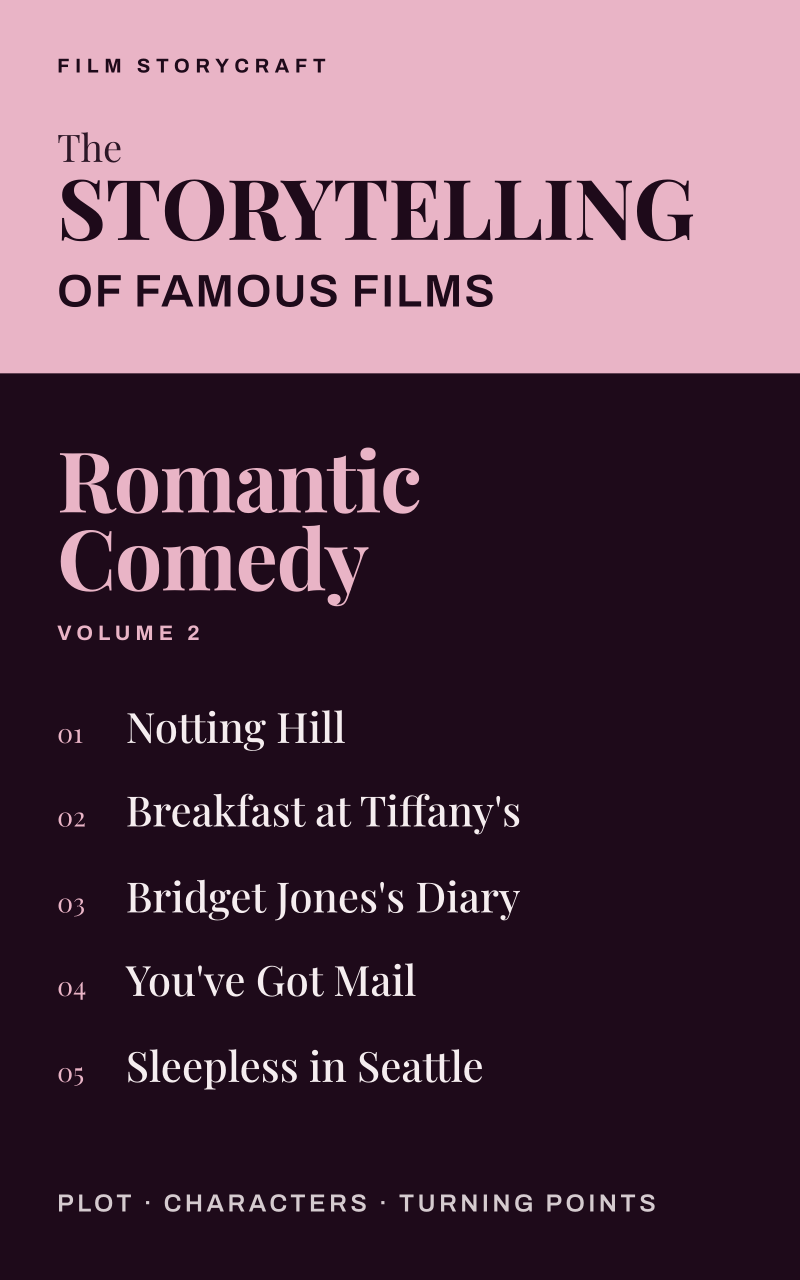
Romantic Comedy — Volume 2: Distance is always a fear
A workshop on point of view and dramatic irony, run through five love stories.
Book language: English · PDF + EPUB
Your ebooks, ready now and whenever you want
- Download right after payment
- An email with your download links, easy to find later
- Your personal library: sign in with your email and download again whenever you want
- PDF and EPUB for common devices, available from your library
The volume
It always looks like a circumstance: fame, money, a screen, an ocean. And it always turns out to be a fear. The moment these films get serious is the moment the character discovers that the obstacle was convenient. Five different devices for the same discovery: one narrows everything to a single point of view and holds the missing piece back to the end; one builds a defense so elegant it passes for a personality; one makes visible the court a woman keeps in session against herself; one seals two people inside a dramatic irony they cannot see and the audience can; the last delays the meeting almost to the final scene and holds anyway. For a writer this is a laboratory in the control of information: who knows what, when, and what the audience is asked to carry while the characters catch up.
The five films, and why they are here
Notting Hill
Restricted point of view as a romantic device: everything passes through one character, and the missing piece stays off screen.
Breakfast at Tiffany's
How to write someone who mistakes flight for freedom, and how to place her in front of the door left open.
Bridget Jones's Diary
First-person voice as a comic engine and as a cage: a ledger of one's own faults kept open scene after scene.
You've Got Mail
Dramatic irony at full strength: the audience knows, one of the two does not, and when the secret falls there is damage to repair.
Sleepless in Seattle
How to hold romantic tension when the two leads barely share a scene.
Inside the volume
- Introduction to the genre: the essay that binds the volume's five titles together and says what to watch for.
- Five analytical chapters, one per film, from the dramatic premise to the legacy of the work.
- Comparative glossary: thirteen or fourteen craft concepts, tested against these five titles.
- Over two hundred pages, in PDF and EPUB, in your account library.