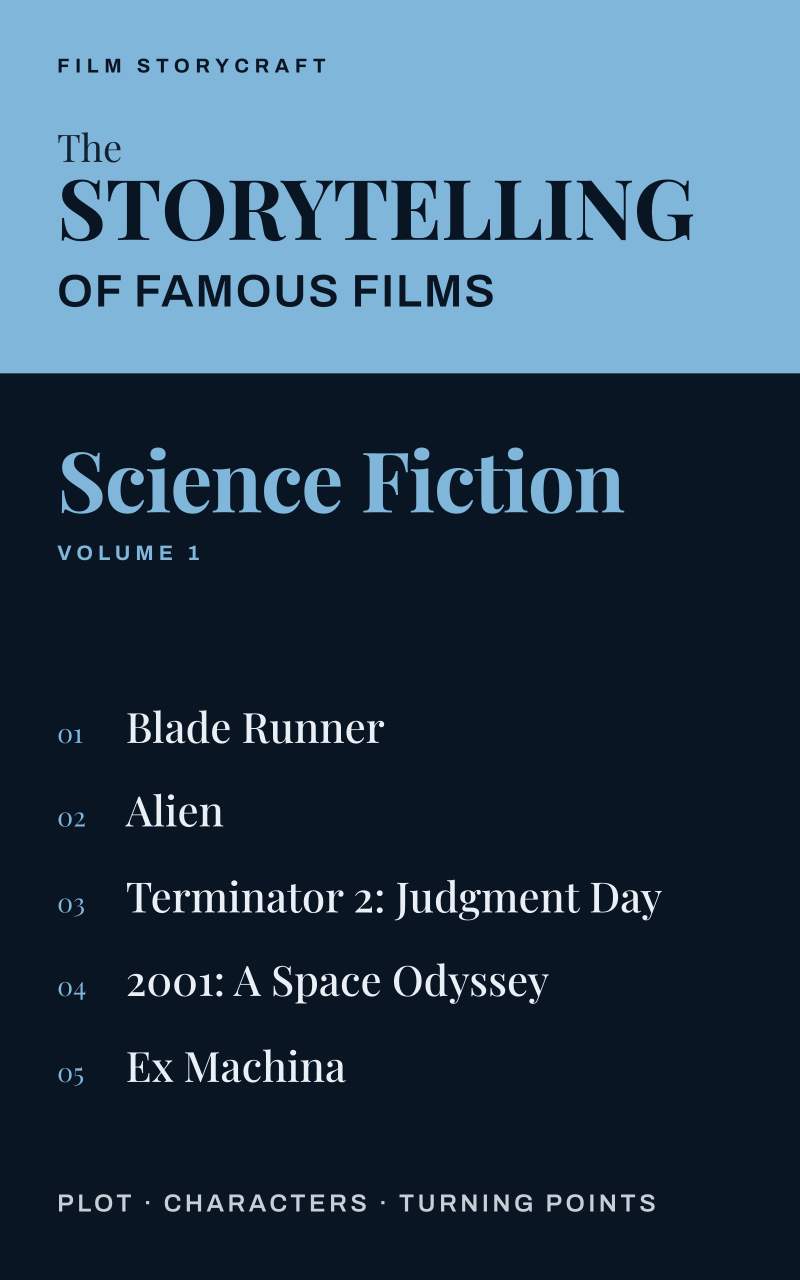
Science Fiction — Volume 1: Standing in front of what we have built
Concept turned into theme, and a world established without stopping to explain itself.
Book language: English · PDF + EPUB
Your ebooks, ready now and whenever you want
- Download right after payment
- An email with your download links, easy to find later
- Your personal library: sign in with your email and download again whenever you want
- PDF and EPUB for common devices, available from your library
The volume
Somebody builds something. The thing built comes back and stands in front of the person who wanted it. And there, at the point where the genre expects the question about what is inside that object, these films turn the camera around: the one under examination is the human being. Not all five put an artificial mind on the field, and that is exactly what holds them together, because the thing built can be a bone picked up off the ground, a science officer who came out of a factory, a military network, a girl made of glass and cable. One assigns the largest change to the figure it had introduced as the threat. One hides for almost an hour which character will carry the film to the end. One sends two arcs in opposite directions and allows them a single crossing. This is the volume on worldbuilding by implication and on concept turned into theme.
The five films, and why they are here
Blade Runner
The largest arc handed to the antagonist, and never announced: a switch that happens in front of the viewer's eyes.
Alien
How to hide for an hour who the protagonist will be, and how to split the danger between the creature and a decision taken earlier.
Terminator 2: Judgment Day
Two opposite arcs that meet once and once only: the gesture that decides the film is the one that never gets completed.
2001: A Space Odyssey
The most famous ellipsis in cinema as a lesson in editing: what can be said by staying silent, and how far it can be stretched.
Ex Machina
A test that turns around: the man who thought he was the examiner was sitting on the wrong side of the glass.
Inside the volume
- Introduction to the genre: the essay that binds the volume's five titles together and says what to watch for.
- Five analytical chapters, one per film, from the dramatic premise to the legacy of the work.
- Comparative glossary: thirteen or fourteen craft concepts, tested against these five titles.
- Over two hundred pages, in PDF and EPUB, in your account library.